

JAPAN 2025 Drawings and reports
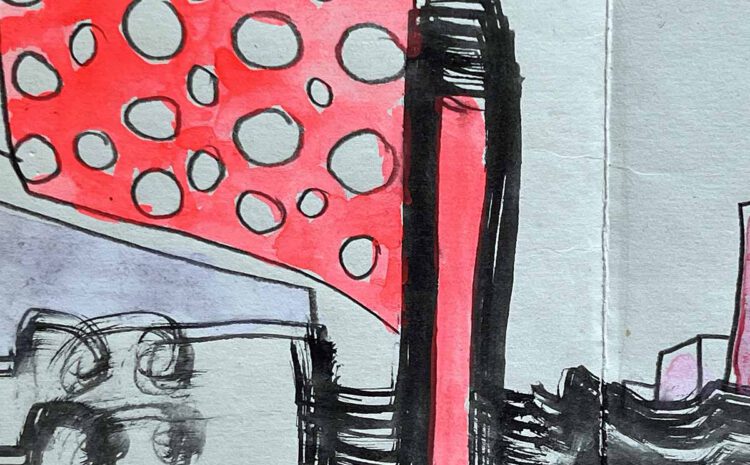
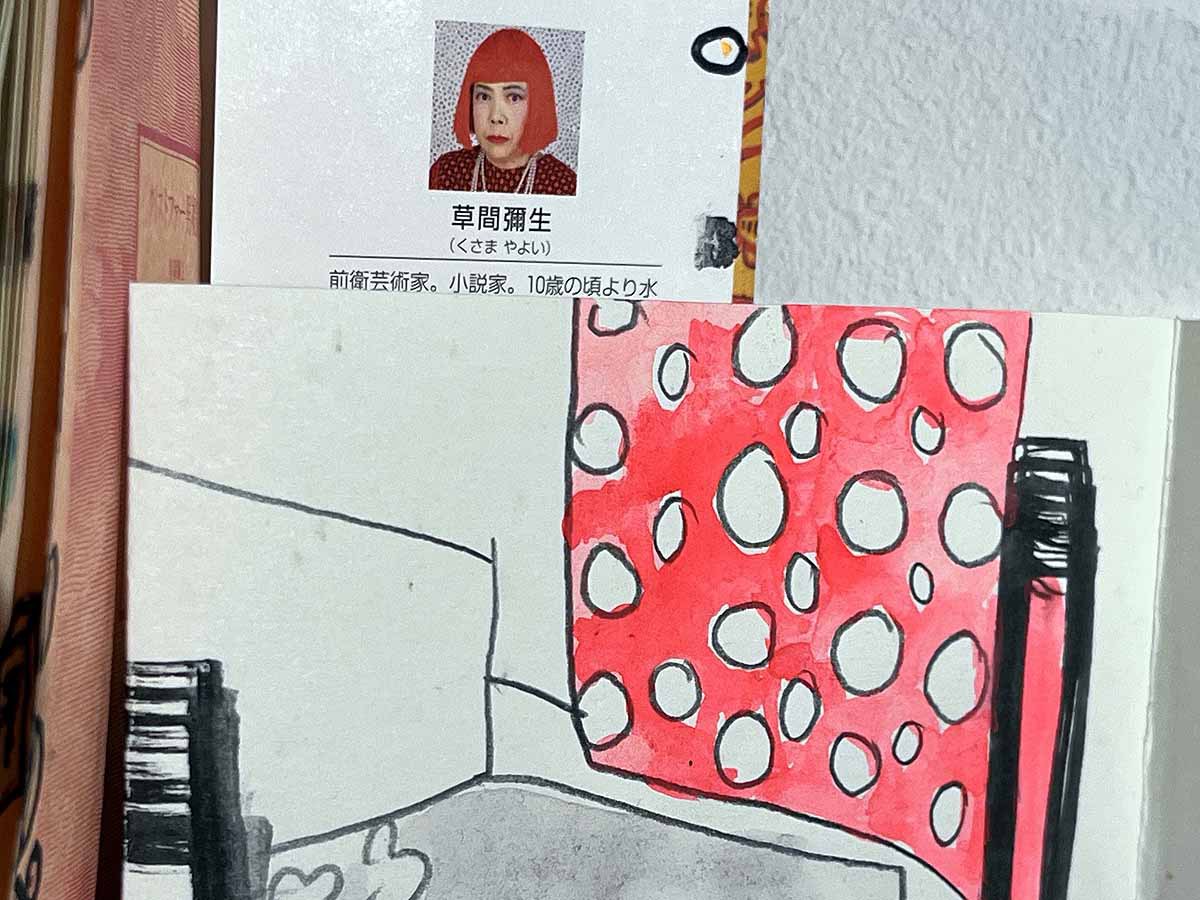
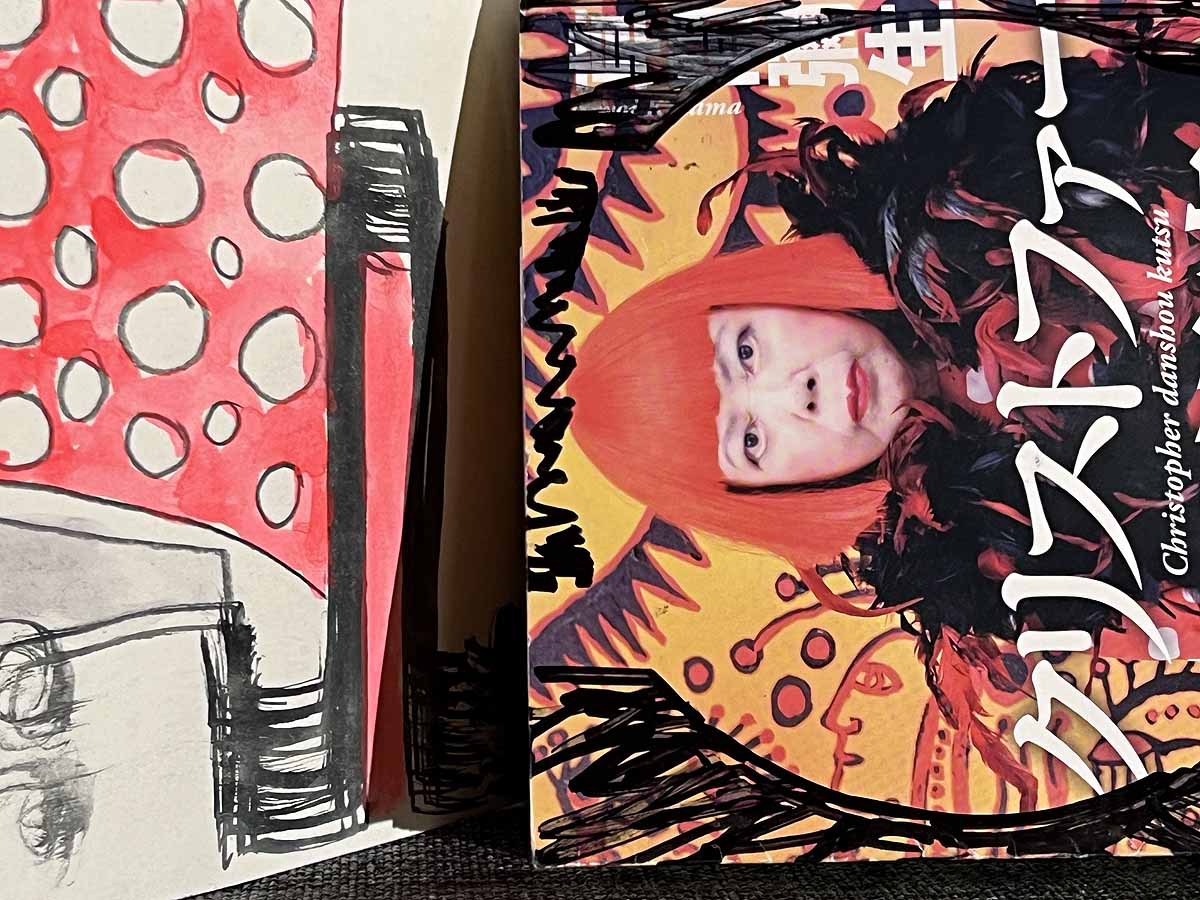
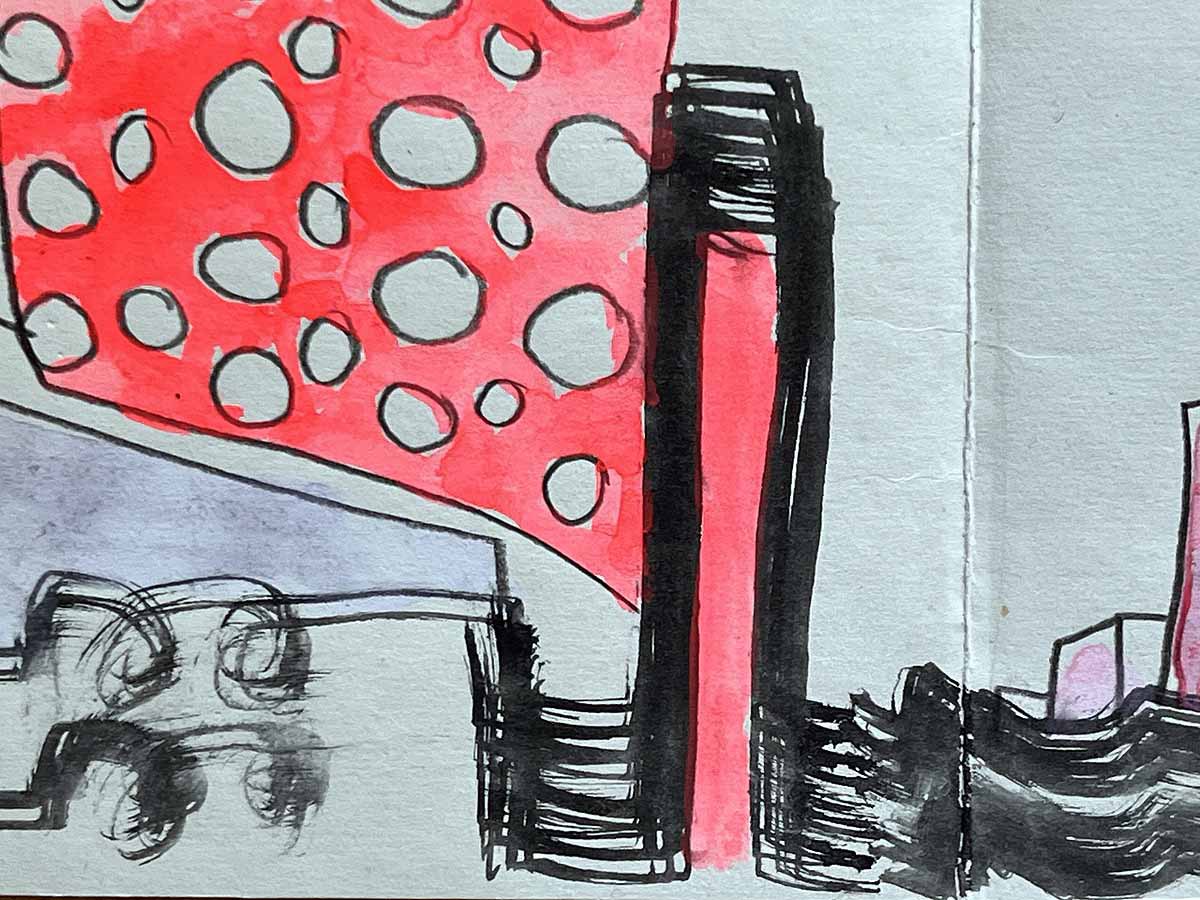
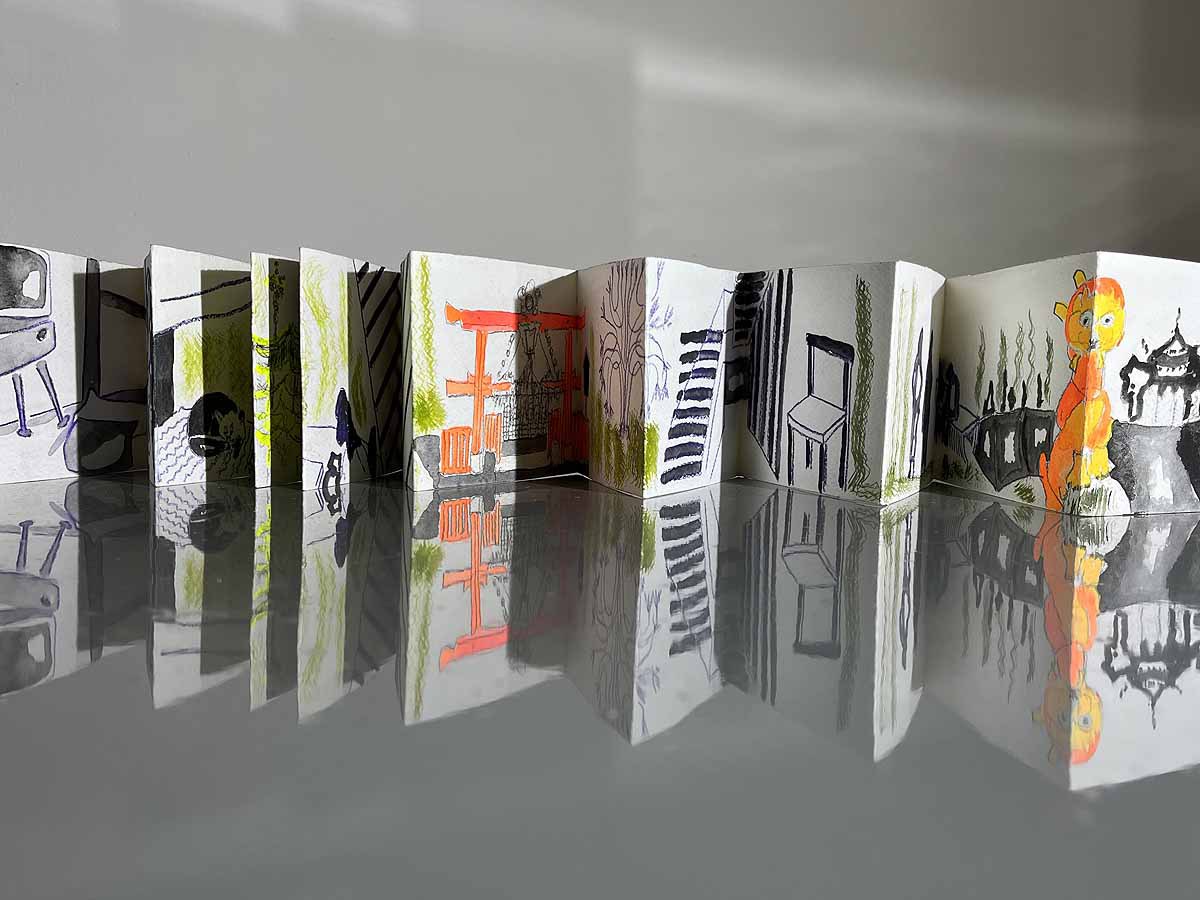
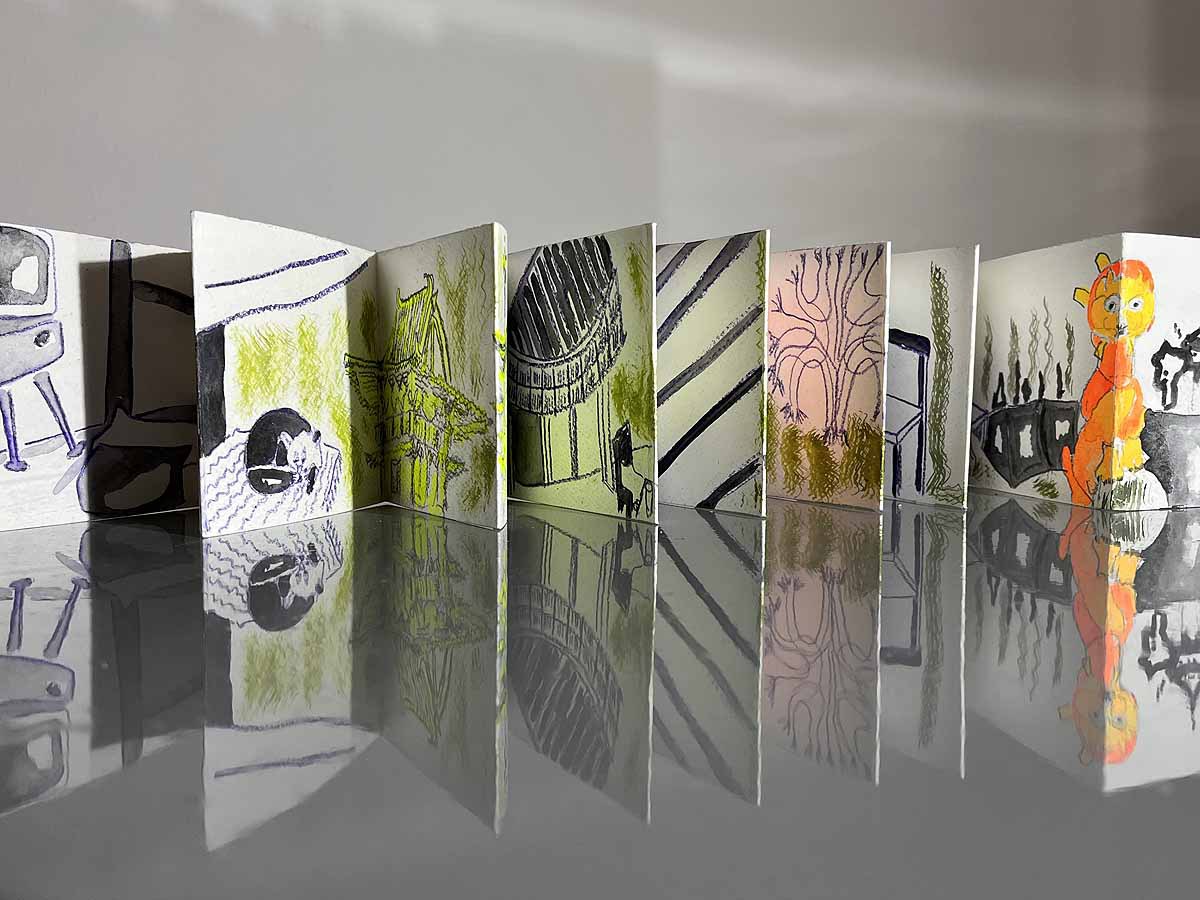
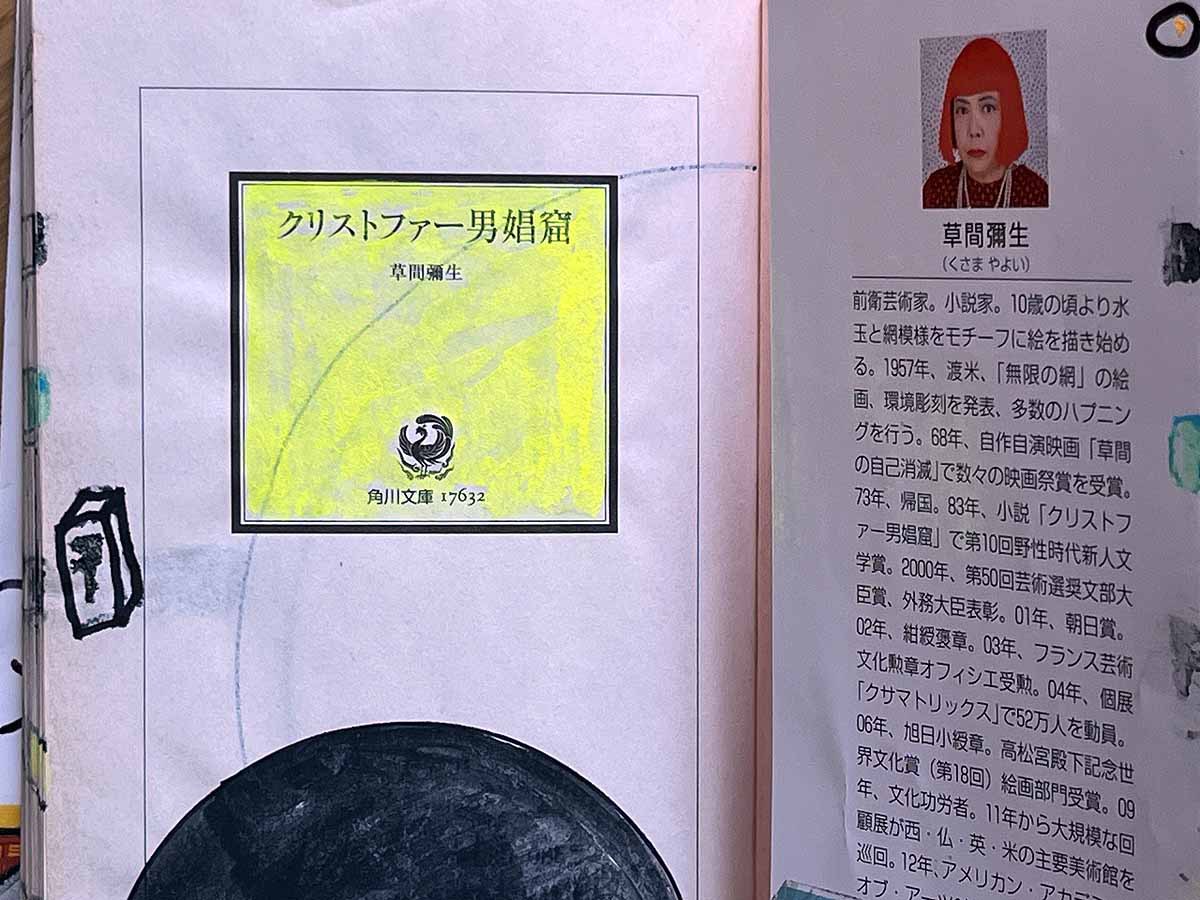
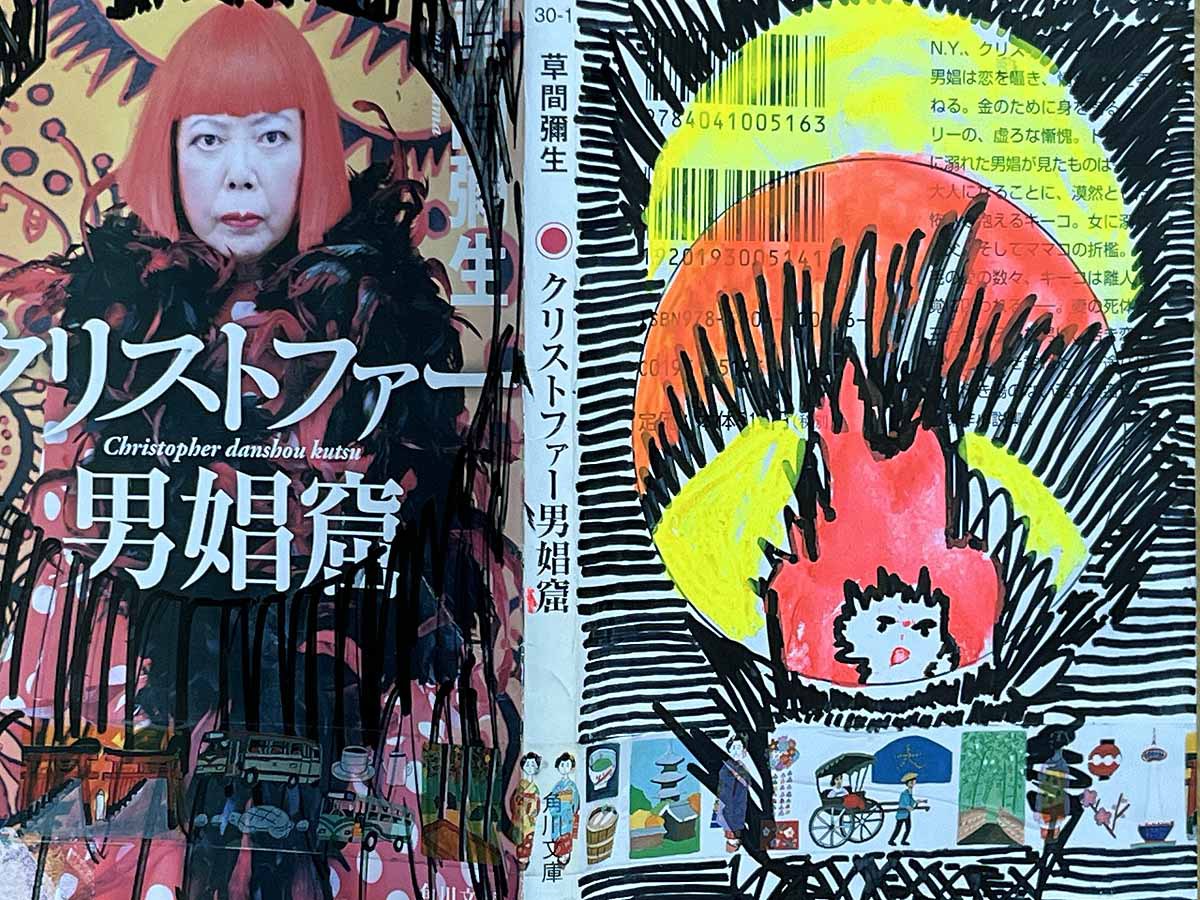
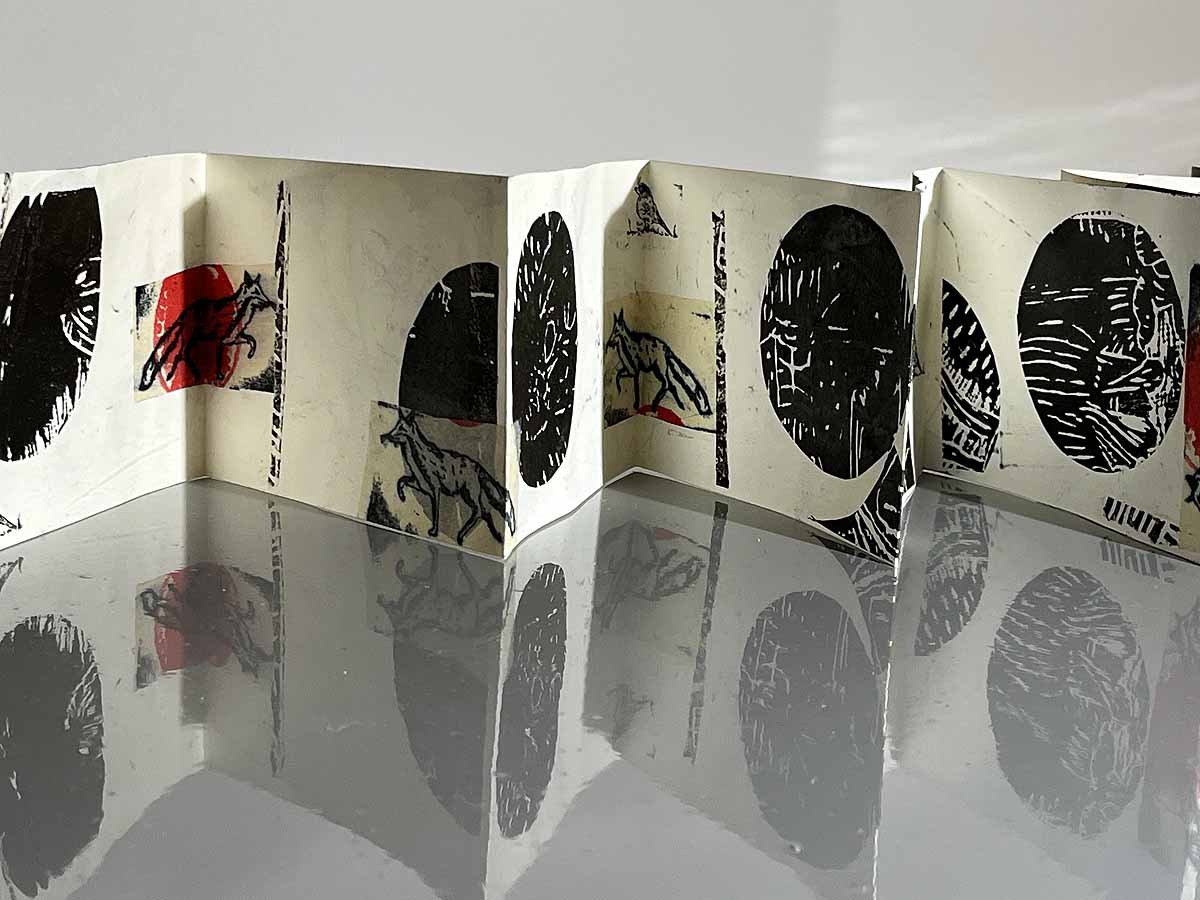
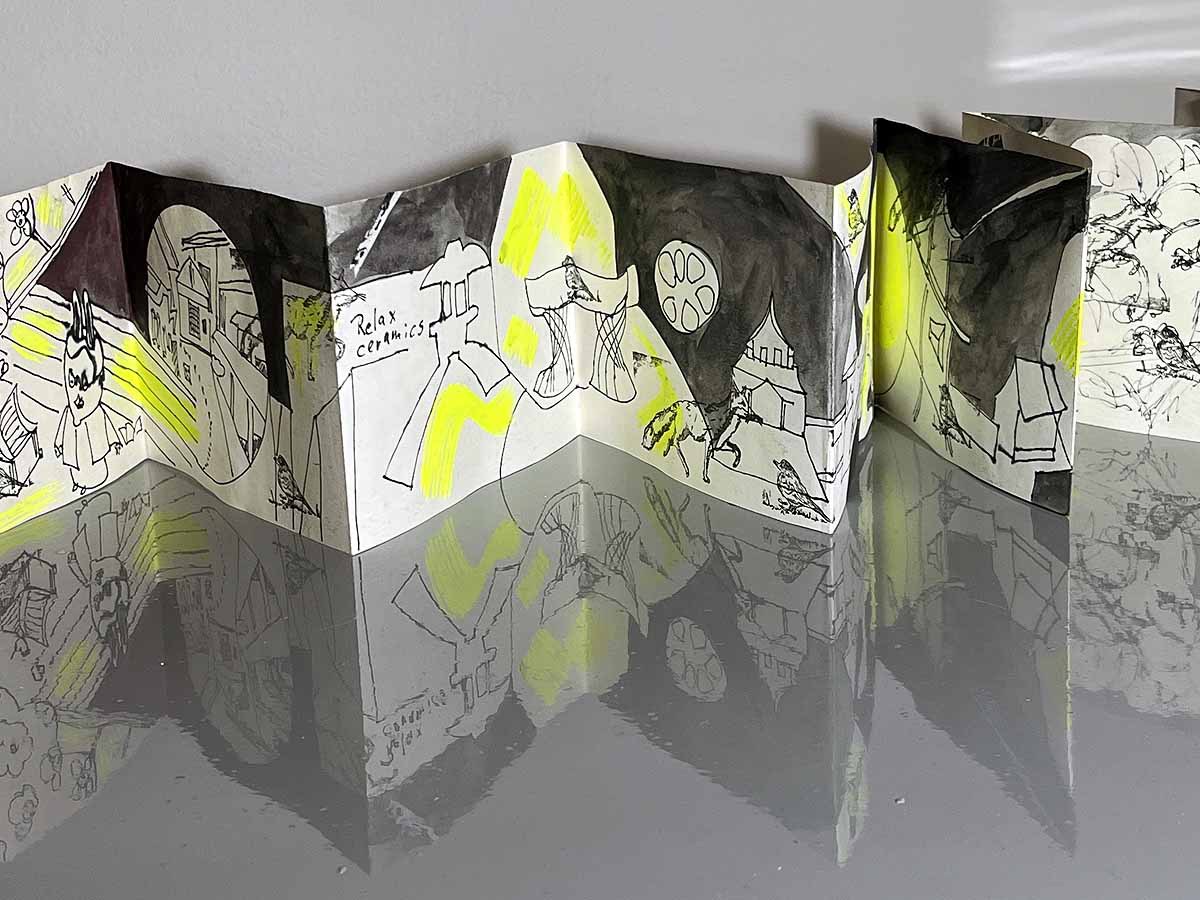
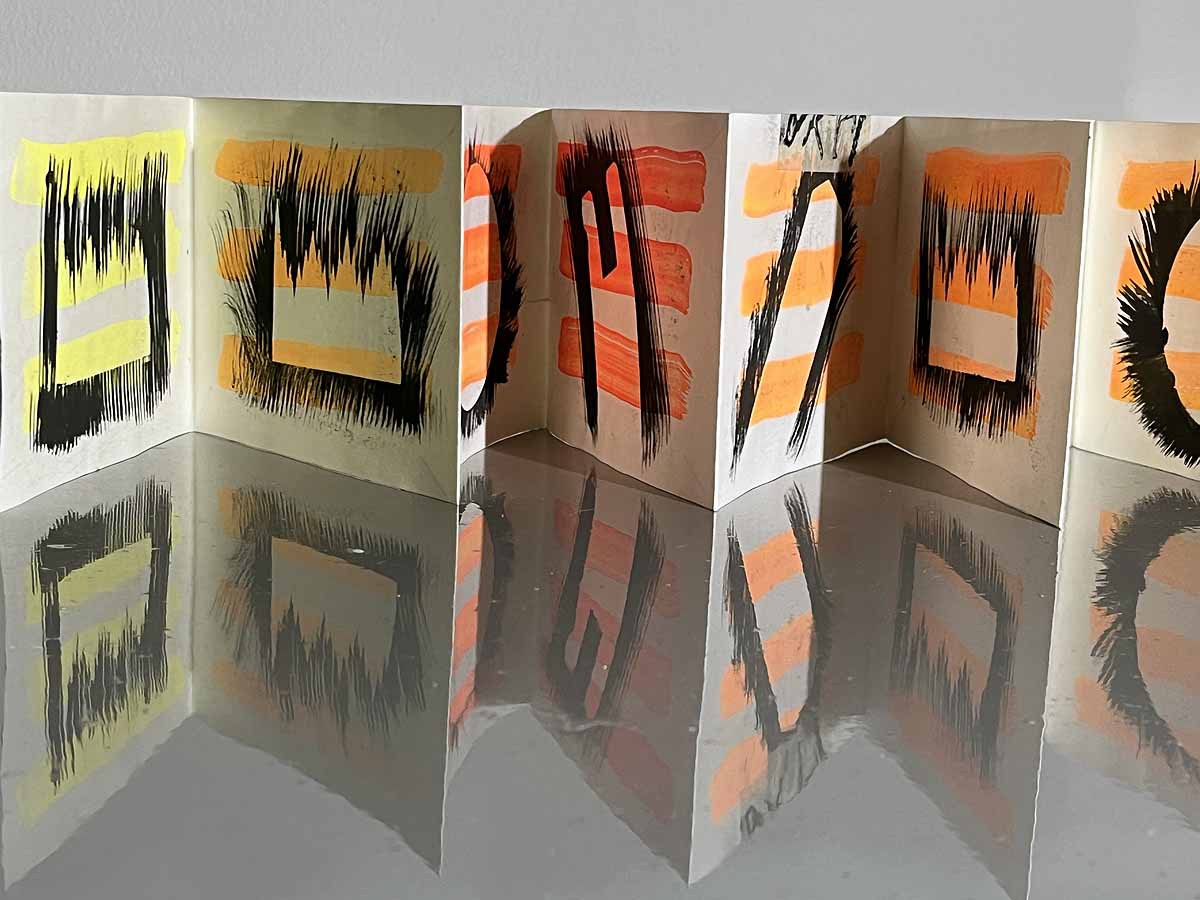
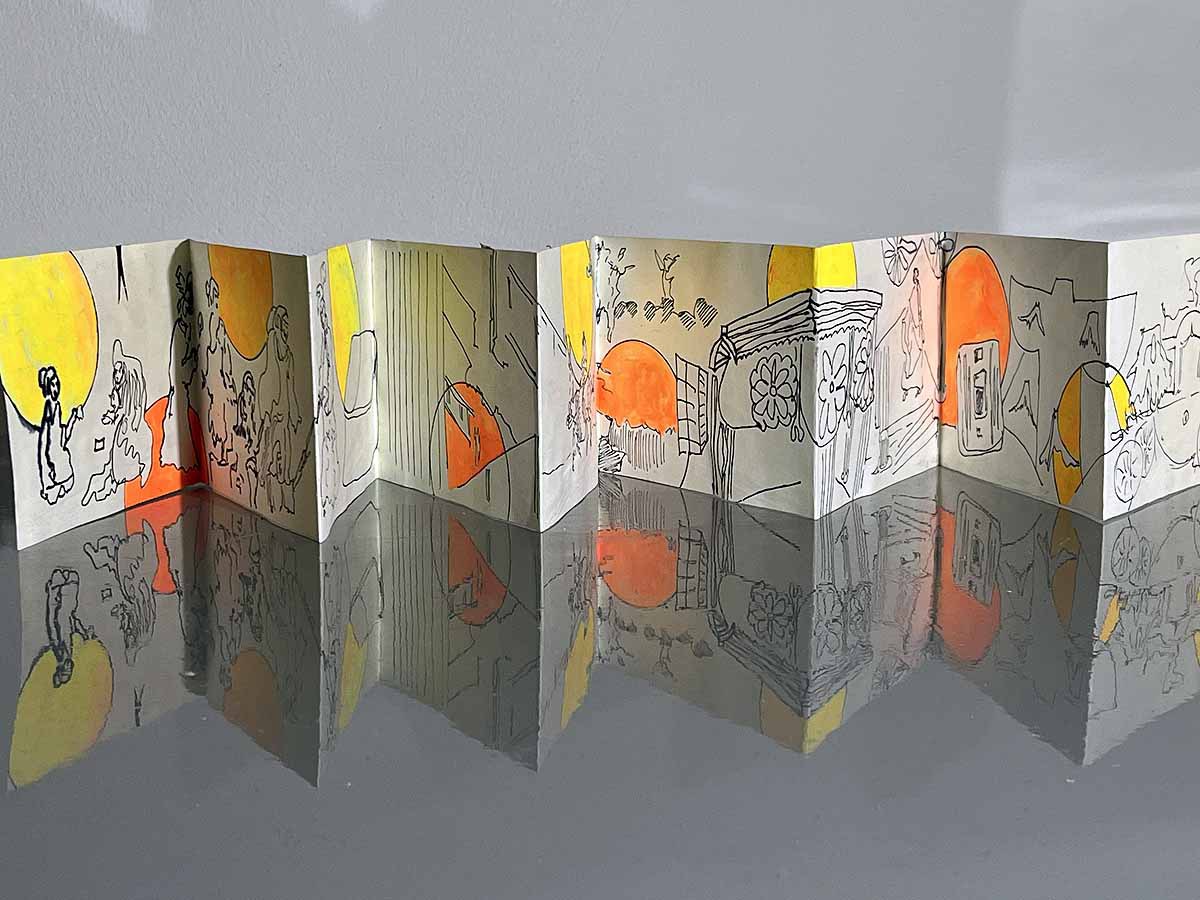
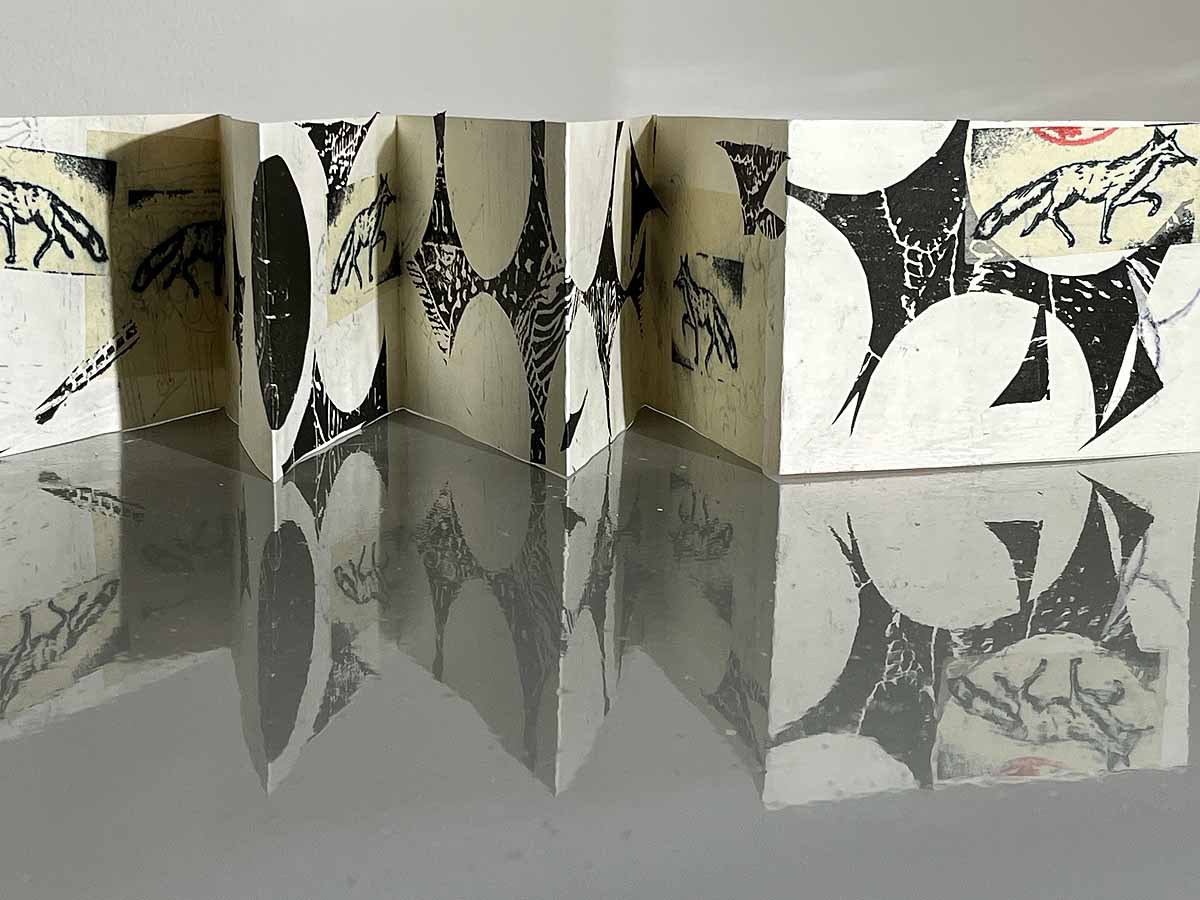
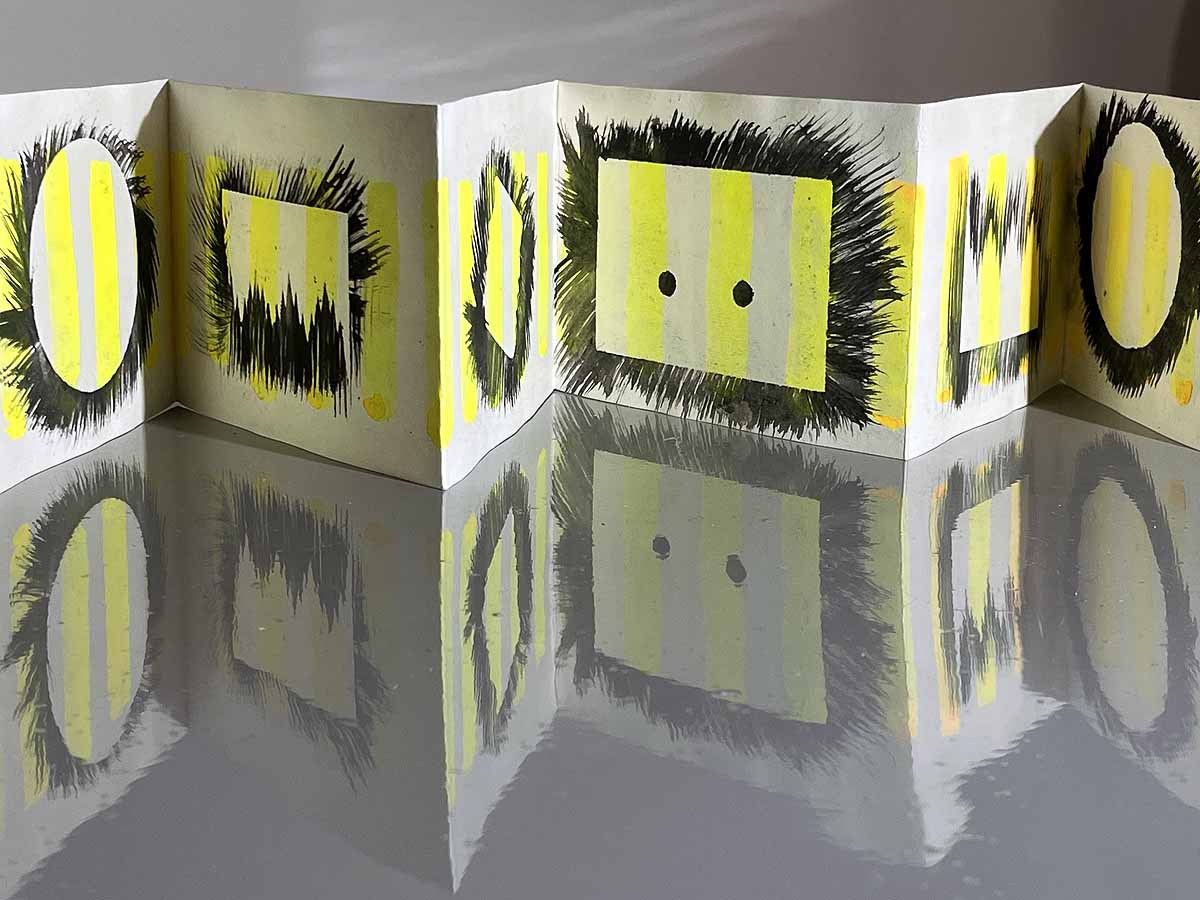
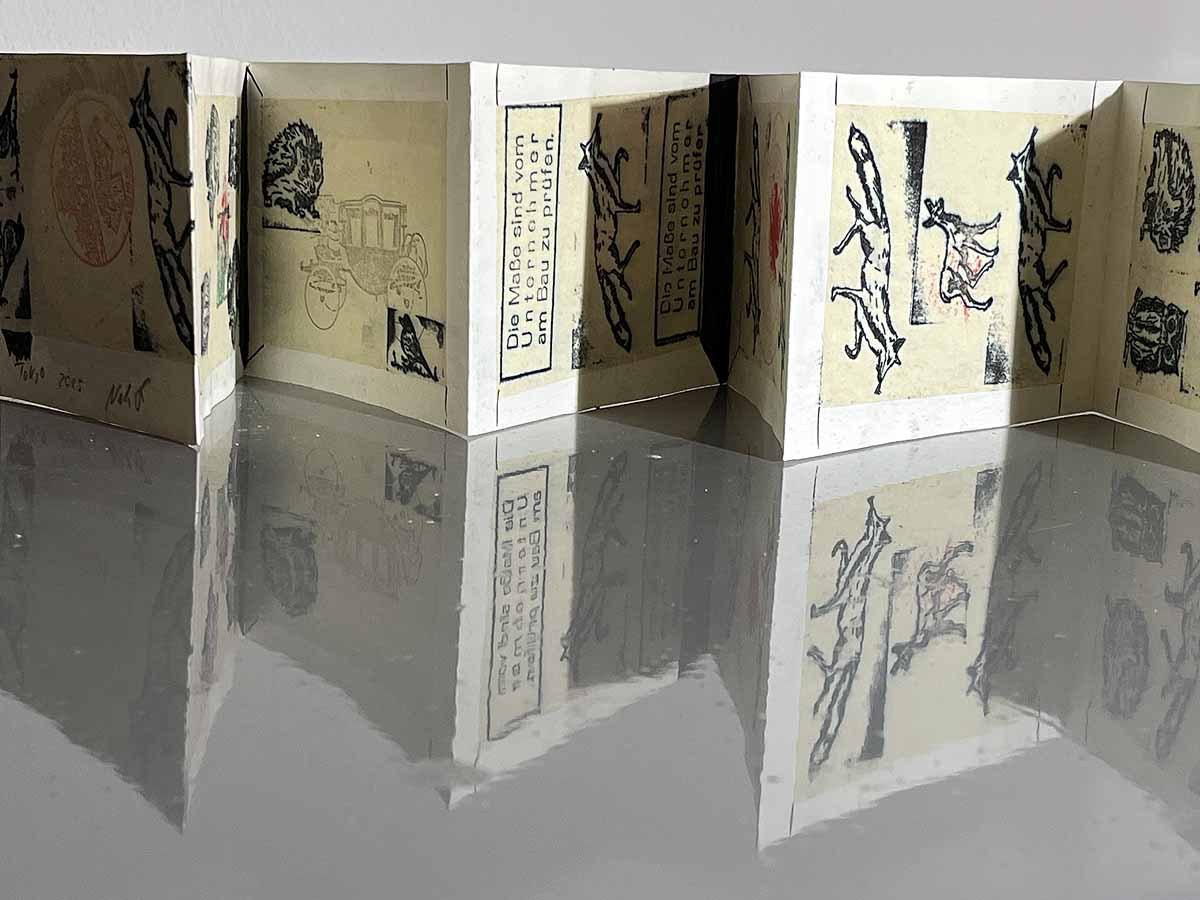
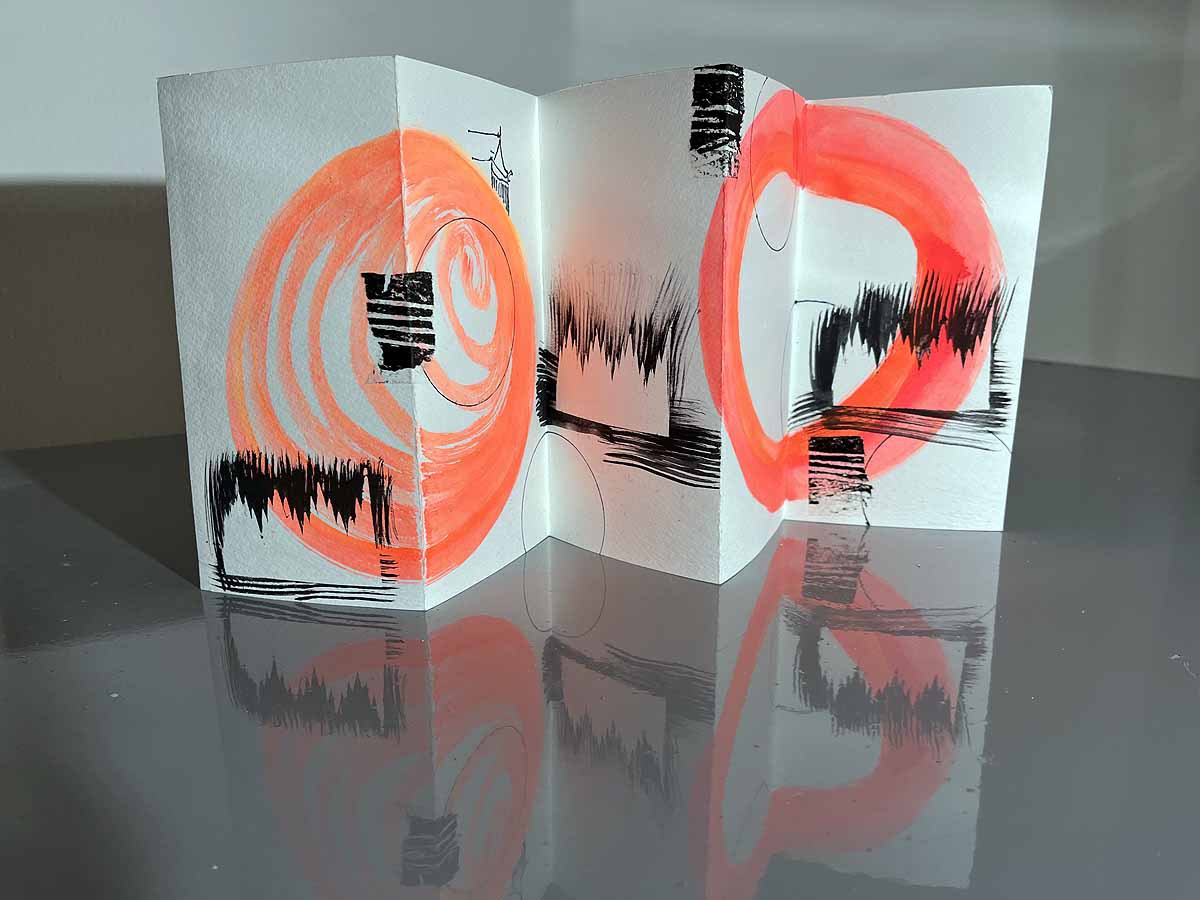
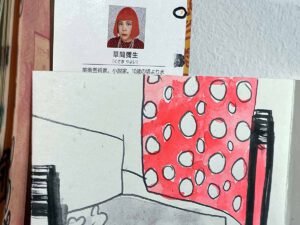
The edited softcover of “Madame Dot” (Yayoi Kusama) and my commentary leporello were created on my trip to Japan in 2025.
It is the story “The Hustler’s Grotto of Christopher Street”, published in Japanese in 1984. I discovered it as a paperback printed in 2012 on a book exchange shelf in Nagano, near her birthplace of Matsumoto.
My research on the Internet and with a translation program revealed that she published this text shortly before her return to Japan in the early 1970s.
It is the story of a woman’s unhappy love affair with a heroin-addicted hustler in New York, which ends in their joint suicide and may have autobiographical traits in parts.
Shortly before my find, Yayoi Kusama turned 96 on March 22 in Tokyo and is still very productive.
I was so fascinated by this early work that I began to work on the pages of the book with my marks and interpret them for myself. It was a kind of communication about her sculptures, which only gradually became dots later on.
In my early days as an artist, I also modeled many phallic-looking sculptures.
These steles were my answer to the strongly male-dominated sculpture of the time.
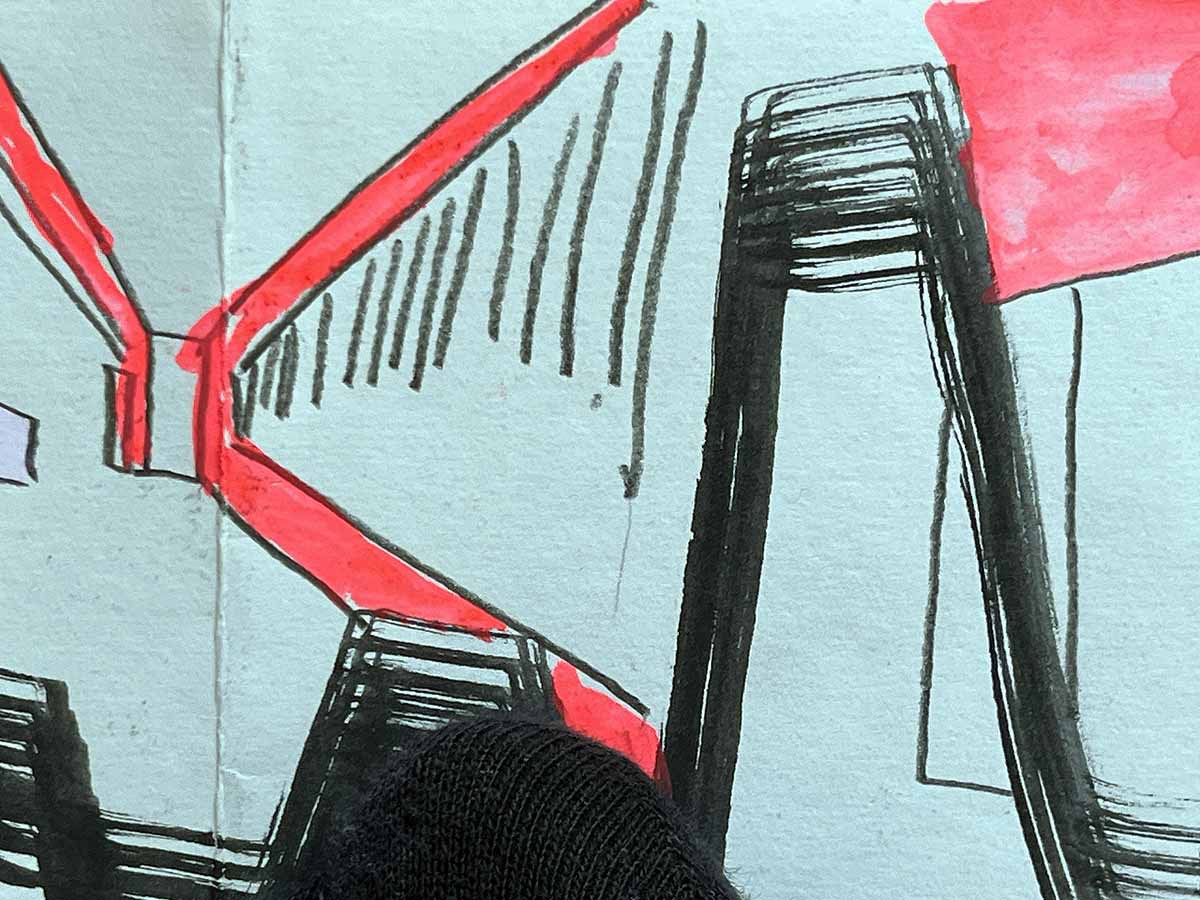
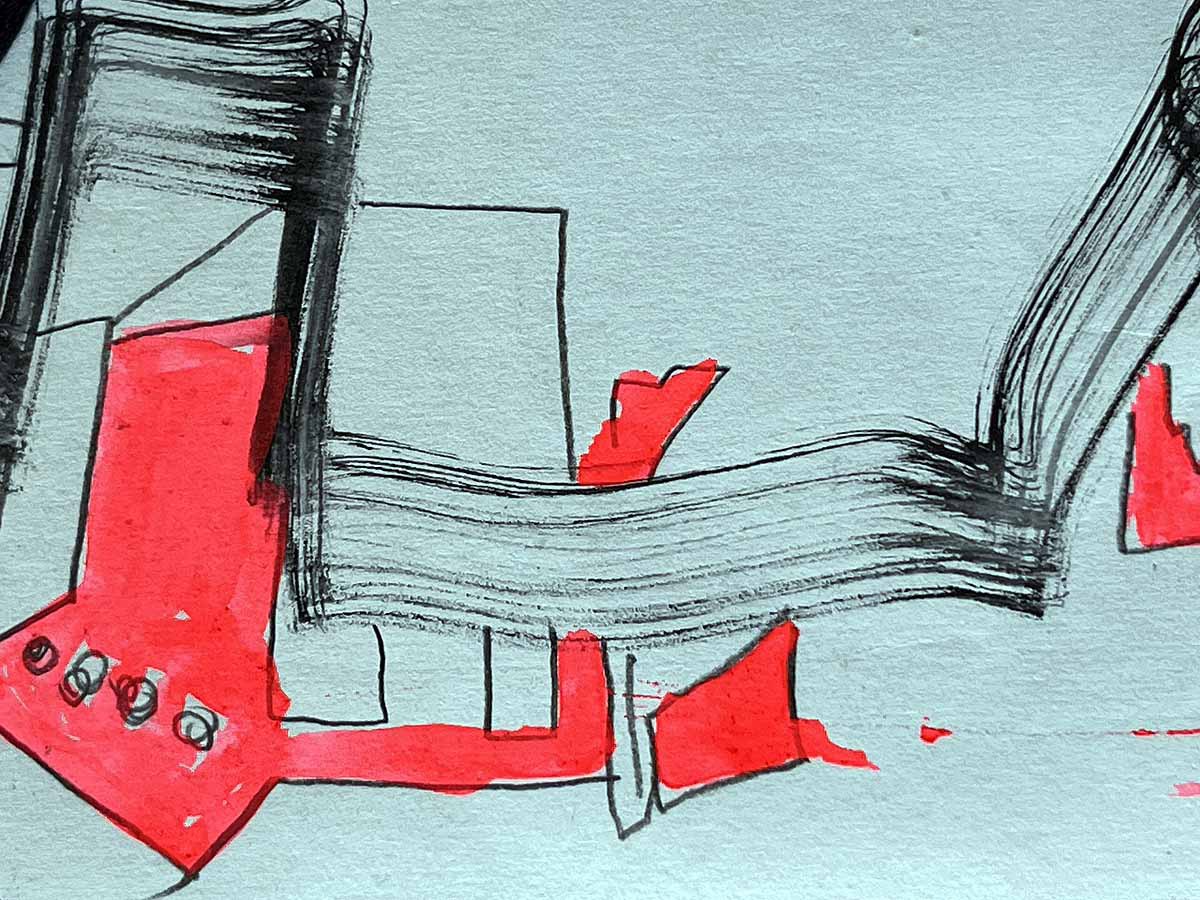
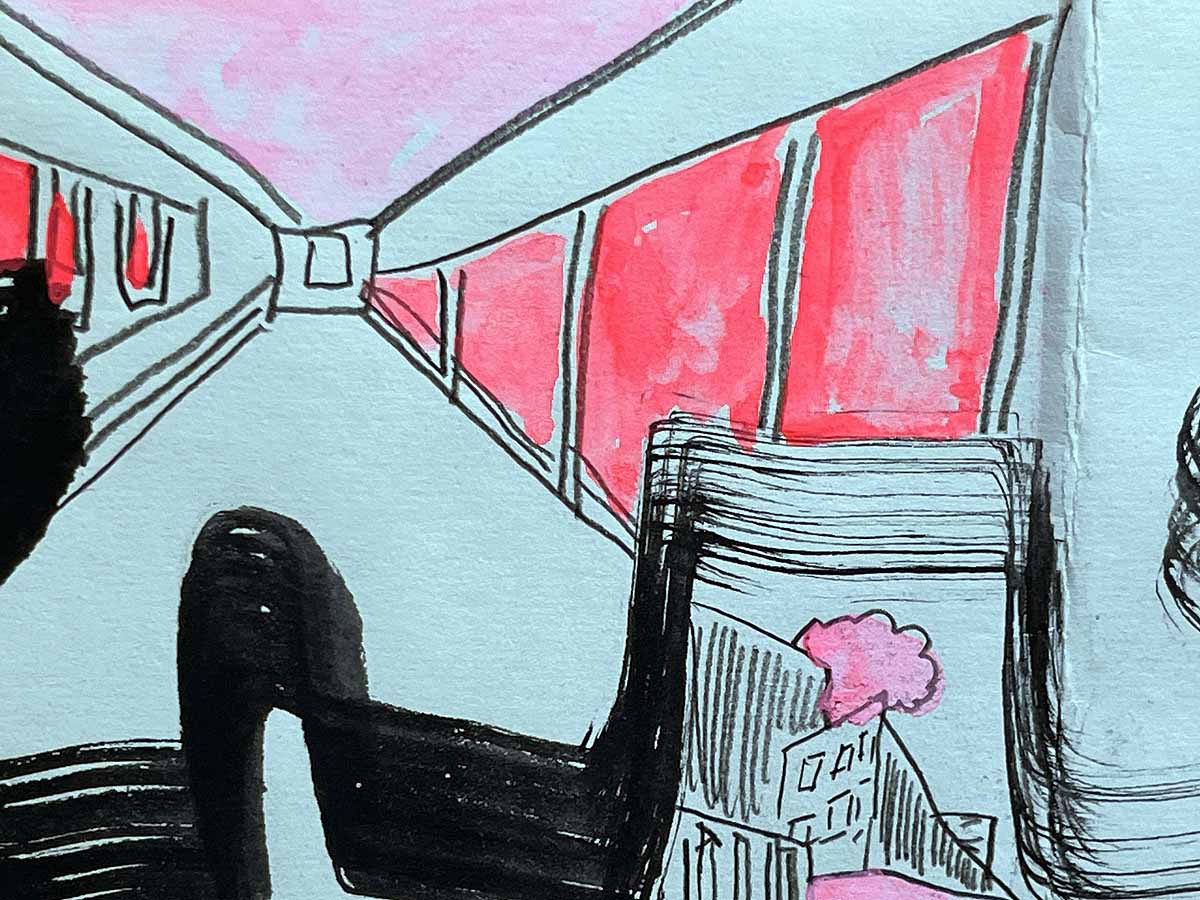
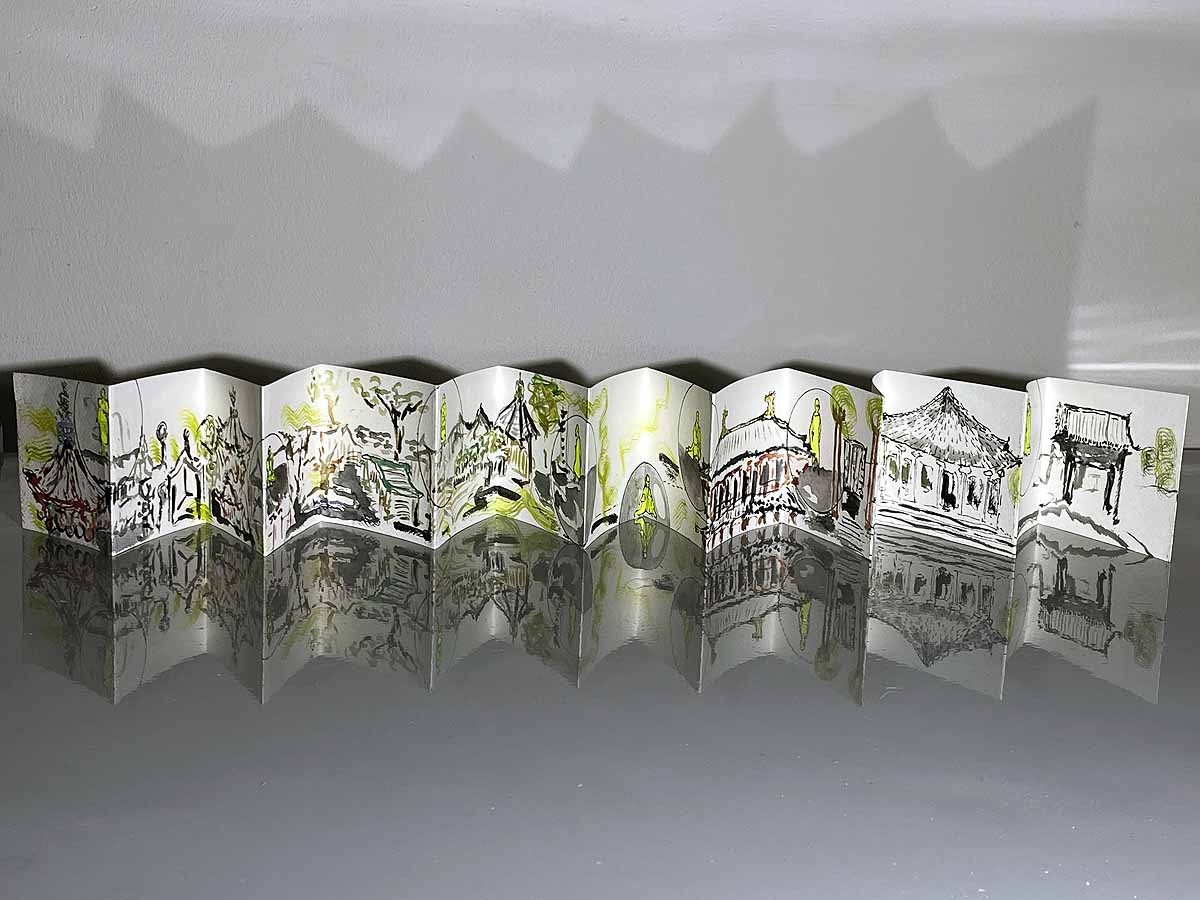
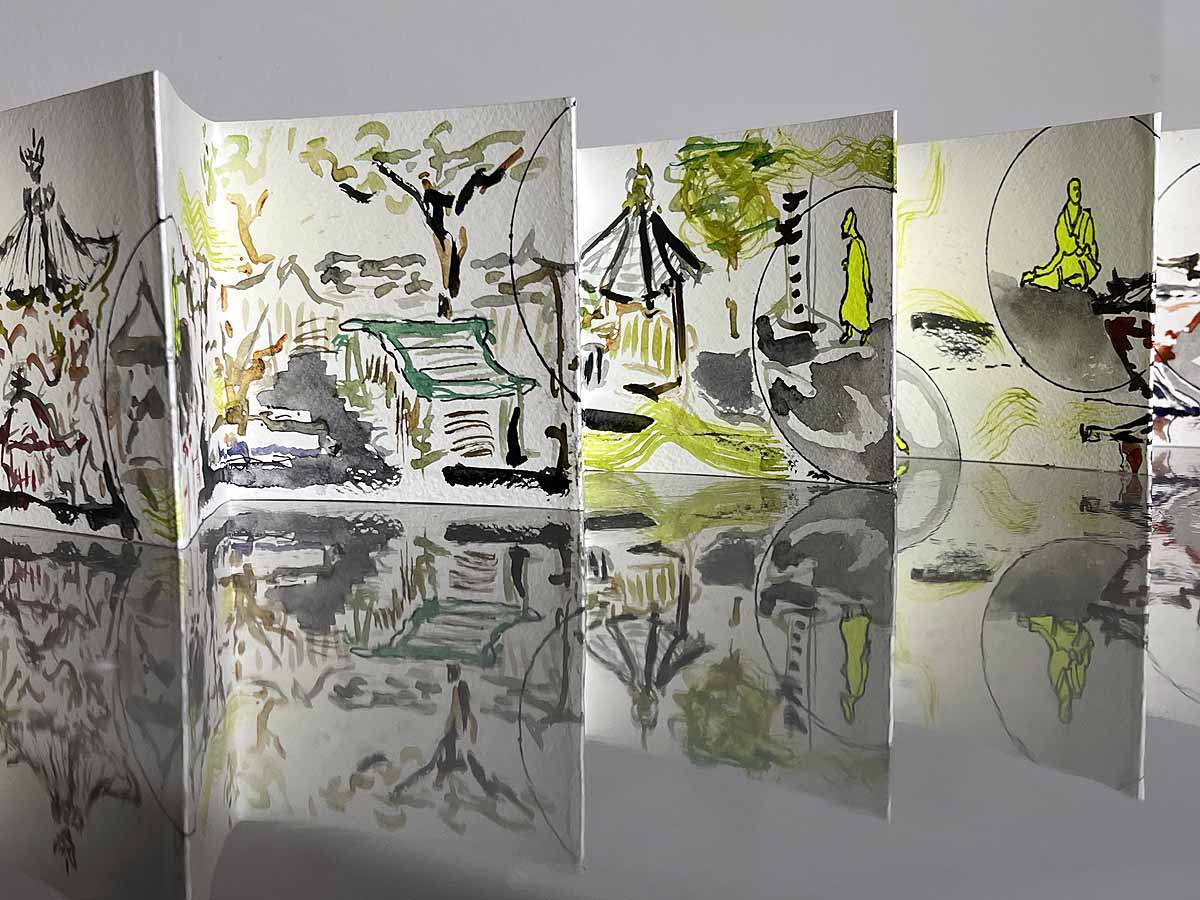
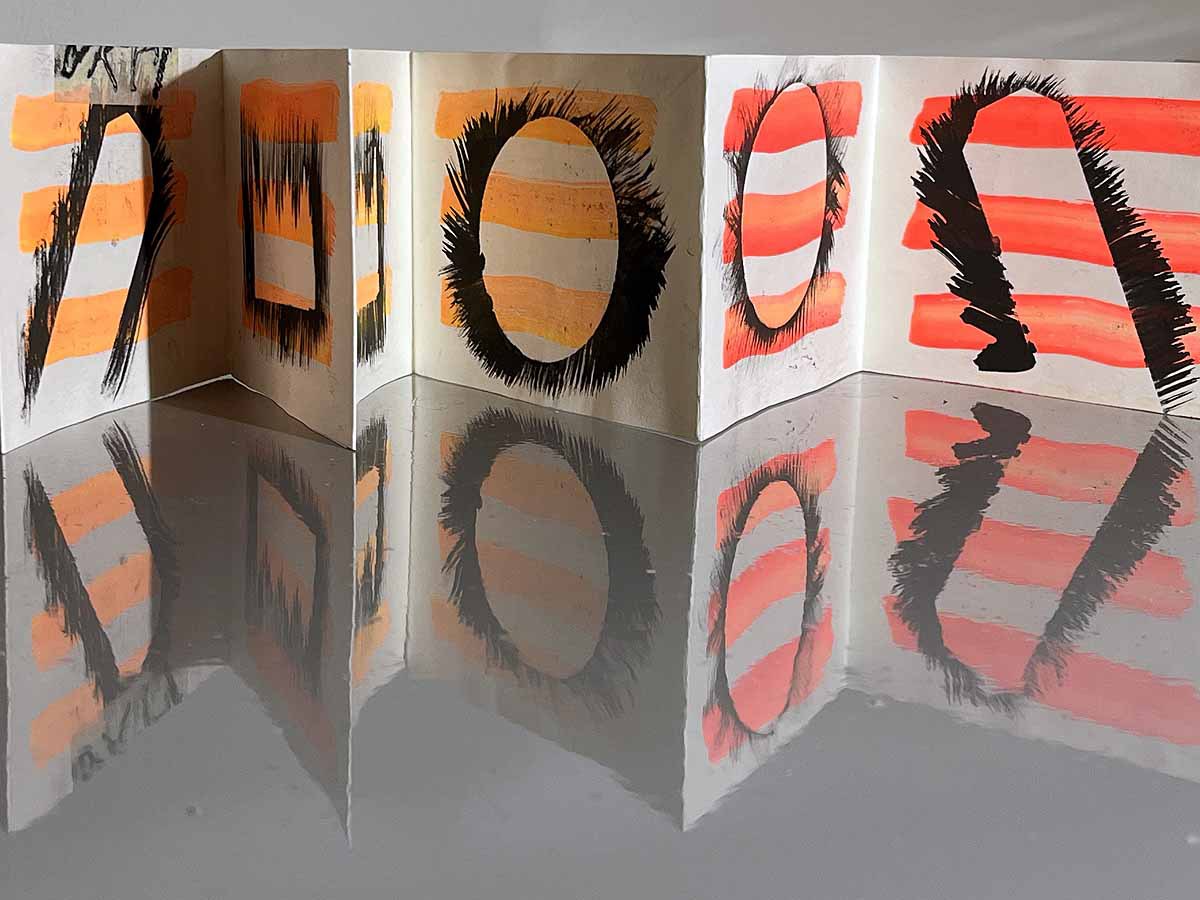
The accompanying fanfold is also designed with Kramer luminous watercolors (lightfast). The brushstrokes were created with the help of Japanese toothbrushes, which are particularly fine.
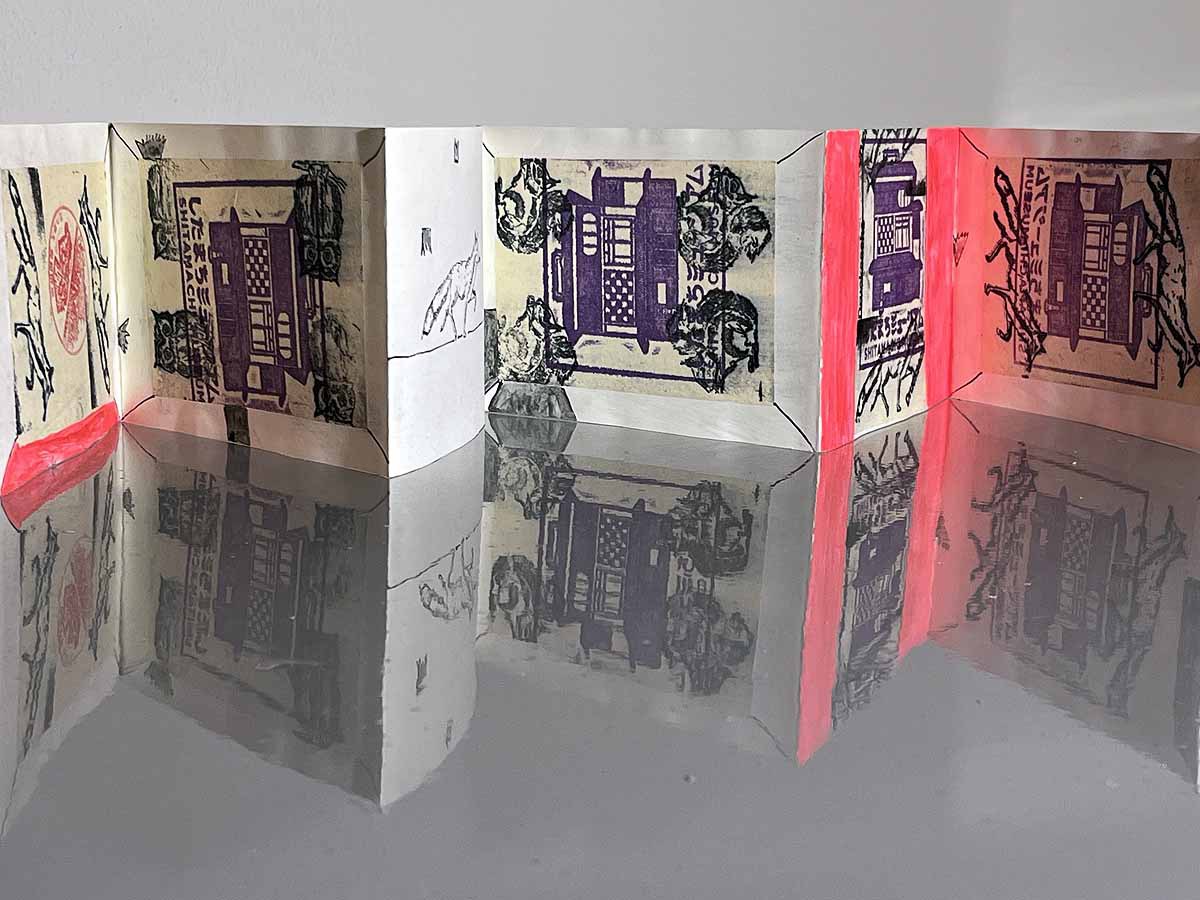
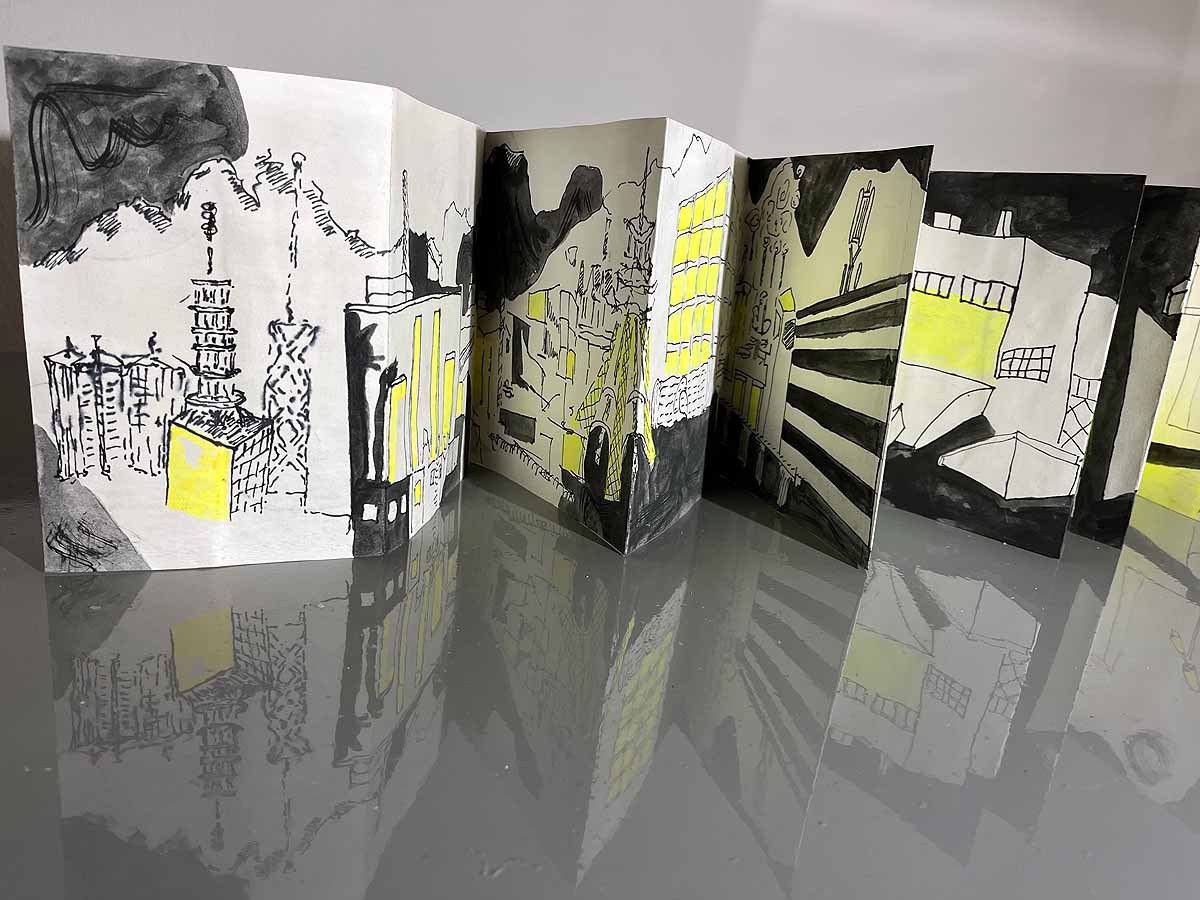
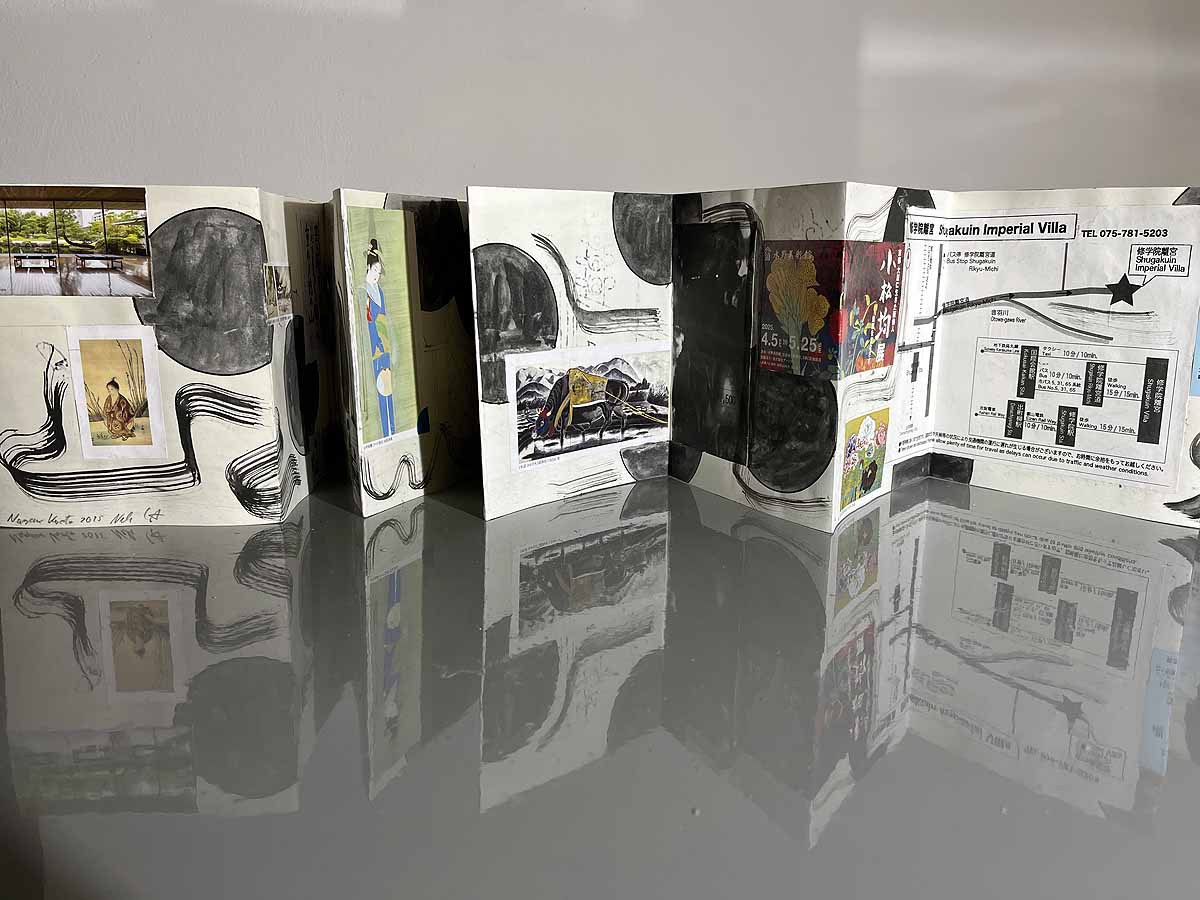
During my 5-week trip to Japan, I painted, collaged and drew around 20 leporellos about my feelings and impressions.
Some of them are shown in a travel report which you can request from me.
Okonomiyaki, takoyaki and kushikatsu
An explosion of synapses, that’s what Osaka station does to me, sometimes to the point of silent tears. Getting in to a certain type of railroad company and its trains in unpronounceable directions is still possible. BUT getting out again and finding the right direction and level home is a real challenge every time. The GPS often fails, doesn’t know the level by default, and the wife wanders around, tired after a long day of visiting. Until she finally manages to find the right exit.
https://www.osakastation.com/osaka-station-map-finding-your-way/
When we arrived after the flight, which was filled to the very last seat, the only option was to take a cab. Even for that we needed a helping hand. Cabs are only signposted for the last few meters.
Otherwise, we are very lucky with our accommodation: really big and really quiet for the Umeda neighborhood, a sunny balcony.
We went to Nakanoshima Museum Island to visit the MOCA, the National Museum and the Ceramics Museum. All strictly Japanese, even the signage, lost without a camera translator. The repeatedly rebuilt castle with its tower was spectacular but too crowded. We then moved on to the magical Shitennoji Temple, a wondrous complex embedded in the skyscrapers with a walk-in pagoda, enchanting frescoes and a gigantic temple flea market. There really was everything from direct sellers, what a pity that this wonderful world was at the beginning of our trip. Otherwise we would have bought more than one kimono jacket and silk scarf batiked with stones for a total of 10 euros. The first cherry blossoms were spotted.
Yesterday we took the JR to Nara to visit the temple complex there with the legendary Golden Hall and to admire all the sacred deer that roam free. A real highlight besides the great old soup house by the pond is the Hotel Setre. It was built in 2019 by Ryuichi Ashizawa Architects & associates Architecture Office- Osaka, Japan. Clay bricks in an earthquake-proof steel frame, wonderfully puristic wooden structures in the individual rooms, a sustainable feast for the eyes. Nara also has a large research institute for ancient wooden sculptures with a fantastic Gangoi temple and historic tombstone garden.
Today we are taking it easy, enjoying the balcony above the rooftops, washing, painting, writing.
On Saturdays, we went to the western shopping district of Namba in search of fruit and vegetables. In the standard stores, every yellow beet is individually packaged, apples in duets. The food arcade is full, with tourist prices. Along the river to the wharf, tic tocers with new choreographies everywhere. We carry a little greenery home.
On Sundays, we walk around Umeda City in search of a neighborhood garden called Shin. But first we ended up at Regens Place, a large open space with a futuristic roof. Pavilions from “how to green my….” initiatives. Everything is mini, including the hundreds of toddlers jumping around on the walking fountain in the cutest way, not forgetting their also very cute mothers. It’s hot. One side of the Shin is traditionally planted with watercourses, the other side of the Umeda Tower is horizontal and futuristic. Both are high-tech and certainly cannot be cultivated by neighborly means. Brown grass everywhere, despite irrigation systems. Japan lacks rainfall and groundwater. The rice harvest was already at risk in 2023. It is said that tourism is also to blame. People in Kyoto might believe that, but more on that later. On the way home, not wanting to wander through the station, we ended up at the Tsuyu No Tenjinja temple. Excited girlfriends and young couples in search of love were everywhere. Praying at the temple bell, heart-shaped invocation notes, everything pink.
To be on the safe side, we check our accommodation in Kyoto in advance. There in 30 minutes on Monday with JR. The satnav leads us to a desperate laundry owner who comes up with all sorts of plans to get rid of us. Finally the right address, we continue to the hotel. Kyoto is very beautiful but really overtourism.
Guests are not allowed into their rooms until 4 pm, which is the same throughout Japan. In some hotels you can book extra time by the hour, for €14 an hour, but only sometimes.
So we left our suitcases in the laundry and went to the Hanazonocho Temple of Jodo Shinshu Hongwanji-ha near the train station. There is an elegant designer pavilion for pilgrims where we could enjoy our remaining carrots. Like all Kyoto temples, the building is made of dark wood with white trim. The interior is very golden and dignified. Various ceremonies are held. The female monks are young and beautiful. Nearby is also Terakoya, the Moorish-style teaching building of Tokyo University. Yes, and then after 4 pm the shock:
“Double the price for half the space in comparison to BON Condominium Umeda Osaka is Apartment Hotel KANSO in Kyoto”.
This apartment has no space to store anything, the only closet for clothes is just a hole in the wall, no shelves no clothes rail. All standard shelves and boxes in the little fridge are gone, so you can cool nearly nothing. In the little bathroom no storage either. Nothing to put your suitcase on. Kitchen has only a one plate stove, one tiny pan, a frying pan without lid, 3 little plastic bowls. Really no place to cook a meal, besides no eating table with regular chairs either. Washing machine only operates cold. Since we already had paid for the week we tried our best to improve. Staff was very nice, but had very little equipment either. The owner of the house must be really keen for every penny instead of having happy guests. We usually do not write any reports because the things are always changing and subjective. But this time we must. Johannes 3th level Genius, Beschwerde an Booking.
You need a personal permit from the imperial administration to enter certain gardens. We got up early and drove to the huge complex at Kyoto Gyoen.
Ms. Maruyama from Germering is sitting there and explains to us in her best German that we have won a day ticket. Normally you have to apply online 3 months to 3 days before your visit. We are lucky and get a tip from a wonderfully goblin-like, repurakōn employee, also in Denglish, to book the other gardens in the local administration in the same way. Yes, and that there are also cherry blossoms at the end of the complex! After the guided tour and ticket purchase, teahouse with a view of the trees and their enraptured audience.
A very ambitious gentleman with white gloves leads us through the Kyoto Sento Imperial Garden. Beautiful and then into the crowded public Imperial Garden. Locals and tourists in the most incredible outfits and body sizes, from dwarves to monsters of all ages, everything is there.
On Thursday at 9:30 Katsura Imperial Villa, the only park that charges an entrance fee (€ 7.-). A guided dream through mosses and pagodas, tea houses with ink paintings, vistas of the finest styled trees and bushes, finely draped pebbles. Despite all the care, this garden has had a water problem since it was converted to groundwater in 1990. After a siesta at the Shugakuin Imperial Villa, out into the mountains. It was raining and the upper, middle and lower villas were shrouded in mist. Romantic, but chilly.
Yesterday was geisha time. For 3,000 to 10,000 yen a day, young couples, young ladies and whole families borrow the equipment, including the toe sandals that take a lot of getting used to, and produce endless pictures. First we were out and about in the beautifully restored alleyways of the Gion district under the strict surveillance of an endless number of uniformed men.
From the amusement park around Maruyamacho City Line 202 (as usual, a very crowded bus), past the National Museum in the direction of Fukakusay Temple with its many orange wooden gates. We have already bought a hand-printed cloth from Eirakuya with this World Heritage Site in Gion. On the footpath to Tofuku-ji Temple with its famous bridge and rock garden, we enjoy the first macha soft ice cream. It cools the rebellious bronchial tubes nicely.
At the Fukakusay, the gau: tens of thousands, costumed or in appropriate casual wear, pushing, photographing, shouting, eating. We went through and then sneaked home in a cab that was miraculously available.
On Saturday we set off on foot from our sleeping place, crossing the river past flower stores to the district around the National Museum, temples and children’s playgrounds under bridges along the way. In Japan’s national treasure, the Sanjüsangen-do Temple, there are 1001 gilded life-size statues of the Thousand Armed Kannon, standing on both the right and left sides of the main statue in 10 rows and 50 pillars. Of these, 124 statues are from the original temple, which was saved from the fire of 1249, while the remaining 876 statues were made in the 13th century. The statues are made of Japanese cypress covered in gold leaf. The 28 guardian deities are very expressive, realistically shaped sculptures, including the two famous statues of F’jin and Raijin, which are worshipped by young families. The National Museum is closed without notice, the “wave” at the Osaka Expo. From the second floor of the 6th century Yasaka Pagoda in the Yasakakamimachi district, I can already see the great Peace Buddha. Very feminine, walkable inside like Bavaria, the monument is an impressive reminder of the unknown fallen of the Second World War. We donate incense sticks for world peace. At the Kyocera Museum of Modern Art, there are endless queues for Monet’s water lilies. This time I also photograph the lunch, fabuleux.
In the woodcut museum, we are left all alone with an astonished employee Google Lens. We communicate with body language. There are original folios from old Japanese masters to Picasso and co, all very exquisite. Japanese woodblock prints were created through a division of labor: artistic design, carver, printer. There were no letters yet, so entire sentences and paragraphs always had to be carved in cherry. The Art Library in Munich is currently showing a large selection on the occasion of the expensive purchase of a print of “Under the Wave in the Sea off Kanagawa” by the artist Katsushika Hokusai (1760-1849) from his woodcut series “36 Views of Mount Fuji”. The sacred mountain can be seen in the background, while a huge wave threatens to break over fishing boats in the foreground. The depiction is interpreted as an embodiment of both the beauty and destructive power of nature, as a metaphor for the transience of human life, but also as a symbol of the West’s invasion of Japan.
The 15 meditation stones in the fair gravel sea of the 14th century Ryoanji Temple are located just outside the mountain in a World Heritage garden with a pond. Cherry blossom everywhere. The murals are very impressive. On Monday, in search of painting materials, we end up in the wonderful Kyukyodo paper store in Shimohannojimaecho. It has been family-owned for 450 years and now has a super new architecture. Then I pack my bags. Then I put my feet in a fish bath, Ofuro. First a tickle, then a feeling of well-being.
Since Tuesday, we have been staying in the old temple city of Kanazawa, which, unlike Kyoto, was spared from the Great War, in an architectural gem, the We share Hotel KUMO Kanazawa near the castle. In 2020, architect/designer Yusuke Seki (1978, Tokyo) transformed a former office building into a boutique hotel. A dream with a modern grid-shaped wooden interior complemented by the existing structural concrete pillars and tiled corners.
KUMU, a Japanese term full of nuances, can mean “to connect” (組む), “to draw out” (汲む) or “to pour” (酌む) and refers to the connections between people and places, empathy and the spirit of hospitality. Such diverse moments can be found throughout the hotel, starting at the entrance with the small gallery where works by local artists are exhibited. In the Kissa & Co tearoom, a modern cha-shitsu with local teas such as Kaga tea with roasted twigs from GEN GEN AN, accompanied by Japanese wagashi sweets from TARO in Kanazawa.
“The connectivity reflects the architects’ intention to relate to a local context that connects both locals and guests and finds a communal harmony in interconnected spaces.” Thus the concept. On the 3rd and 5th floors there are kitchenettes with large wooden tables and works of art. The laundry is adorned with a sculpture and a wall of transparent white clothespins.
On Wednesday, we visited an exhibition for age-appropriate equipment. There are 100 different types of rollators alone, from functional to trendy designs and for every budget. Also canes and shoes, all at a fixed price. Autonomy is lived here without robotics. There are many young people working everywhere, the state support is so low that often tiny figures, who feel over 100 years old, are still working. Yesterday we bought our baguette from one of these little ladies. I first had to track her down in person in her bakery (due to hearing loss?).
It was a day of architecture: the museum for D.T. Suzuki, a not uncontroversial Zen philosopher (Nazi collaborator) by architect Yoshio Taniguchi. The MOCA extension in NY and many other landmarks are his work. He built the Kanazawa Architecture Museum building together with his son Yoshirō in the middle of the temple district above the city. The special exhibition there was about the city of the future using a circular library building. Unfortunately without subtitles, Lens is overwhelmed.
Thursday, April 3, after the rain had subsided, walk from Oyama Shrine to Tamagawa Park, supposedly the most beautiful park in Japan. I was more fascinated by the Imperial Gardens in Kyoto, which were also almost tourist-free….
In the castle, you can marvel at wonderfully inserted attics with exclusively wooden connectors. Huge trunks literally nestle into each other. In the old geisha district of Higashiyama, I drink my first matcha latte in a small teahouse. Just like the soft ice cream, it takes some getting used to. The Geisha Museum is beautifully furnished. Music room, kitchen, changing rooms, lots of rounded corners, all dimly lit.
On the way home Sori Yanagi (June 29, 1915 – December 25, 2011), retrospective. I want to move in right away and have everything. Everyday design/industrial design at its finest.
Yesterday I shot a video with TOTO to say goodbye to this friendly toilet that opens immediately when I come near it.
After an hour on the Shinkansen, we arrive in Nagano in the middle of the mountains, the venue of the 1993 Winter Olympics. We stay on the 11th floor with a view over the great station and a magnificent mountain panorama. The room is western-style and has a desk, a high round table and two chairs. Breakfast is served on tatami mats on the 12th floor. Shoes off, but comfortable at long tables with a wonderful design and view. It is the most beautiful and delicious breakfast I have ever had. I’ll pass on an illustrated book about it…..We also had an evening meal in a separate room. The breakfast ladies were transformed into beautiful geishas and served an incredibly delicious and lovingly prepared 6-course menu including all drinks for €90. The next morning we were especially appreciated and thanked again, hard to believe.
Sunshine, today at the large Zenko-Ji temple, a Buddhist complex from the 7th century, 17 degrees and almost only Japanese tourists. The gigantic temple guardians (the “Niōs” Naraen and Misshaku Kongō) are carved out of wood with the same bravura sculptures as the guardians in the Sanjüsangen-do temple in Kyoto. Michelangelo’s David was not created until 1504, and it is truly astonishing that these two works of art stand in the open, protected only by a rabbit fence and the wooden gate. My suggestion for inclusion in the UNESCO World Heritage List.
On the road to the temple is also the Art Deco house Fujiya Gohonjin, a great mix of American bar and tea salon that is also used for weddings.
In the Edo era, “Fujiya” regularly hosted feudal lords of the Maeda family who ruled the Kaga domain. In the late 18th to early 19th century, the provincial lords had to serve the central military government every other year under a system known as “Sankin-Kai”. They traveled back and forth between their territories and Edo (now Tokyo) every two years. The Mizuno Museum is very beautiful with its overall architecture between the landscaped park and the museum rooms, great details, the art very local and rare. The brilliantly built Prefectural Museum by Miyazaki Hiroshi is similarly puzzling. Masterful rooms without exciting works of art, much of it empty like the Humboldt Forum.
From Nagano, we visited several places on local trains. Matsumoto, the birthplace of Madame Dot, Yayoi Kusama, now 96 years old and still extremely active. I discovered her New York novel “Christophers Bordel” from 74 and reworked it with drawings and texts. It’s about a heroin-addicted boyfriend who actually has to work as a straight hustler and is managed and loved by the narrator. The whole thing ends in suicide…..
———
Matsumoto, a magnificent samurai fortress. Ueda Castle, a cherry blossom destination with a line-up in front of the old shrine of many locals. On April 7, we return to the enchanting town of Obuse with its stylish museum of Hakusai and the magical villa of the great calligrapher Nihonnoakari. Here is a collector’s screen showing all the “views of Mount Fuji”. Then to the curious museum of Japanese lamp art. From crooked tallow stalks to wondrous oil lamps fed by cast-iron rats and all the lanterns! At the station, the stationmaster sells giant apples and bottles of juice. We’ve also often seen railroad officials trading. Vegetables, home-baked goods and all kinds of handicrafts are sold in front of the barriers, scanned when purchased and then paid for directly. Along the railroad lines there are fields of hard-working officials and pensioners everywhere who earn some extra money.
We also visited the monkeys in the snow bath of the hot springs, together with all the parents dragging their little ones through the mud or even pushing them in baby carriages. AND local pensioners in slippers. Japan is really surprising.
Yesterday, as expected, we arrived in Tokyo on time with the Shinkansen.
Bright Saturday sunshine and queues of people everywhere, at entrances, stairways, means of transportation. Fortunately, we were traveling light and were able to get past all the queues to find the right exit from this juggernaut of a station and push out. Keep left and there is Ginza. We make our way to the apartment building through parks and entertainment districts, past children playing, hip shoppers and groups of Indian visitors. It’s just like New York, but more diverse. Chic and stylish alongside neighborhoods and morbid charm. And then the eternal unraveling of signs and image combinations. Real power food for the synapses.
Our house is on, or rather in, a multi-level city highway. Balcony, 5th floor, the worst are the motorcycle racers, kamikaze sound, worse than any ambulance. There are regular races with tuned vehicles, all night long on the night streets. Just around the corner is the Tokyo Tower with great viewing platforms and lots of brightly styled Japanese selfies in front of it. The next morning I quickly booked the top platform. Now, in bright sunshine, it was closed due to wind. The view from the lower deck is also impressive. We can hardly believe much of what we see and hear and can’t stop marveling and drawing.
On the way, (despite pouring rain) to the Bellesalle Shibuya Garden Sunday flea market at the Mori Art Museum, named after the Japanese astronaut landed. Louise Bourgeois spider lurking outside. Warm greetings from Tokyo, where a very interesting exhibition on Japanese Underground 68 is currently running: https://www.mori.art.museum/en/exhibitions/mamresearch011/index.html and of course “machine love” on AI and gaiming with great artists: https://www.mori.art.museum/en/exhibitions/machine_love/index.html
Districts such as Kaguazaka invite you to take a stroll. Quirky old buildings next to architectural stringency and boldness. A poster with a cat calls for a poetry competition, English is also permitted. Children in Tokyo, a separate chapter. They are very well-behaved and well-dressed in their pre-school uniforms, greet politely, very resilient, almost uncanny and not a few. The sun is beating down in Hamarikyü Park. Now it’s really hot. The chic harbor development is reminiscent of Oslo’s Bay. On the top floor of Matsuya Ginza, I buy my favorite Lamy pen, which hasn’t been available in Germany for years, and delicate papier-mâché bowls, more perfect than porcelain. We’re in the famous department store because that’s where the excursion to Mount Fuji will start the next morning. It makes sense to try out complicated routes beforehand. On the way home we visit the Royal Garden from the outside, otherwise we would have had to go through the royal portal again.
The trip to the sacred Mount Fuji was wonderful and blessed with the best views. Charming encounters with ex-AFS students from the USA and Albania, Your neigbours dear Germans. Lunch with Trump opponents from California. The onward journey of the Motohakone was closed due to a storm. Also the cable car, island stop. It’s crazy how many Indian families are on the road, some of them very eccentrically dressed, self-confident women. All equipped with a big navigation thumb. The irises are in bloom at Tokyo Tower. We then visit the chilly Ueno Park with a great museum on the everyday culture of this artisan district and an impressive shrine, the imperial museum with calligraphy between classical perfection and emblematic, even comic-like transfer.
The Citizens of Calais and the Thinker in the National Museum of Western Art and then the absolute hammer: the Metropolitan. Architecture from 1975 (Mayekawa Kunio Associates) at its finest. The furniture design, see https://finnjuhl.com/inspiration/stories-and-news/finn-juhl-and-danish-chairs-exhibition-in-tokyo is brilliant and comfortable. What is also striking: lots of great art on the building and landscape architecture. On the way to the futuristic station, eccentrics and homeless people everywhere, otherwise rather invisible. The temple in Yoyogi Park is so crowded that we don’t go to the Meji Shrine. The sacred forest around it has a beautiful new Imperial Museum by Kengo Kuma, the great master builder of wood. On the very last day, we ended up in Kishiwada in search of a flea market. The castle with its beautiful gravel garden was a real discovery. A wonderful farewell to this impressive country.
The first travelogue of my life, that’s how important this memory is to me!
Cordially Nele Ströbel 2025
www.nele-stroebel.de


